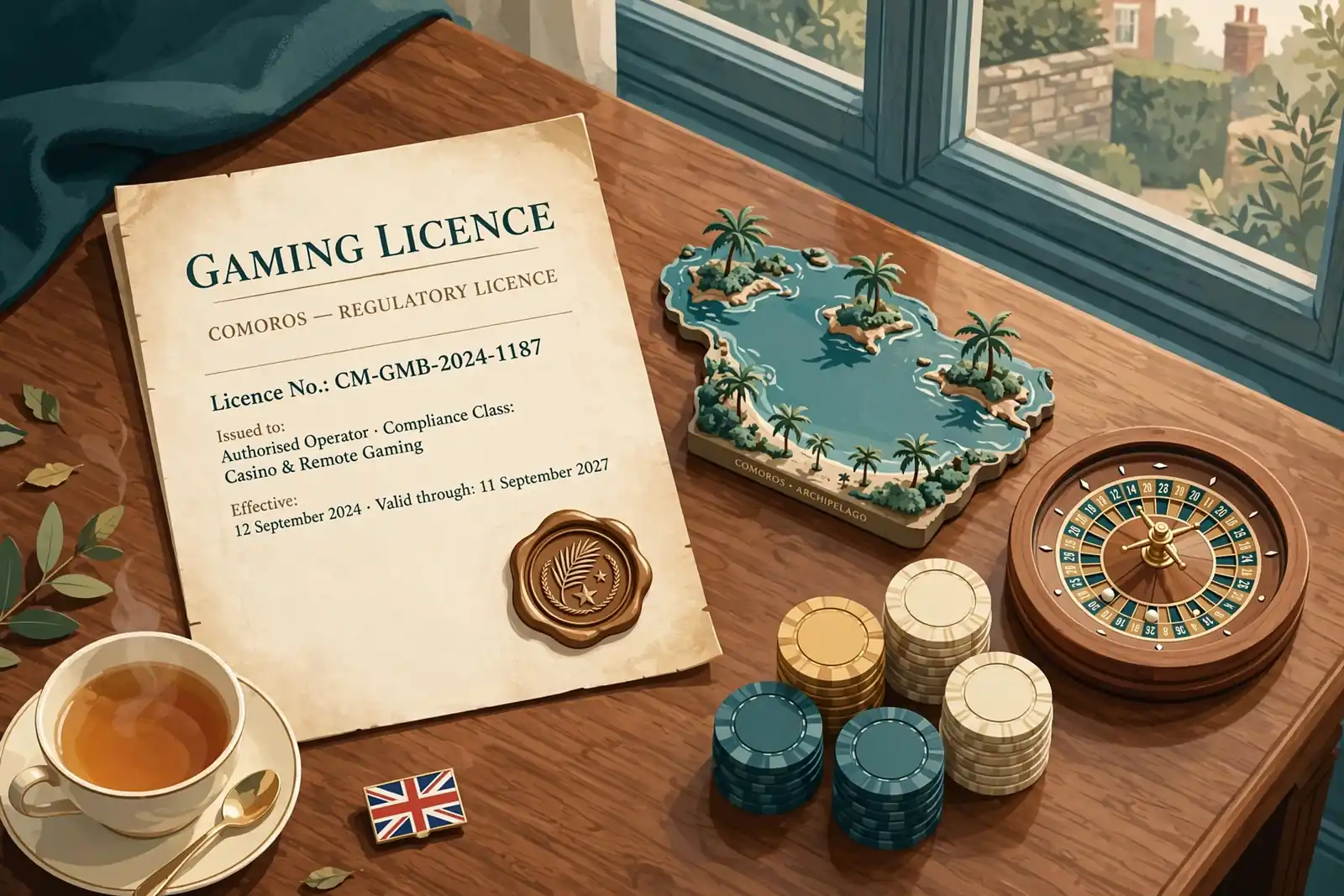
USA casinos for UK players: licensing and risks
 Available in GB
The American branding matters less than the operator’s licence, withdrawal terms and safeguards available to UK players.
Table of Contents
- What “USA Casino” Means When You’re Playing from the UK
- The Legal Line for UK Players
- Why Some Sites Accept UK Players—and Others Don’t
- Deposits, Cashouts and the Risk of a “Fast Payout” Promise
- American Casino Claims, Licensing and Industry Connections
- A Small Deposit Doesn’t Settle the Bigger Questions
- Free Spins, Bonus Terms and the Real Cost of “Friendly”
- How Long Can a Withdrawal Really Take?
- How to Read Reviews Without Mistaking Them for Protection
- Real-Money Play: GamStop, Tax and the Safeguards You Give Up
What “USA Casino” Means When You’re Playing from the UK
“USA casino” sounds like a clear category: a casino based in America, built for American players, and somehow available to you in Britain. In practice, that label tells you less than it seems to. When a site is described as a USA casino for UK players, the important question is not how American its name or look feels. It is who operates it and whether that operator holds a licence from the UK Gambling Commission.
For a UK reader, a foreign casino is an online gambling operator that takes British customers but does not have a UKGC licence. These sites operate under licences issued offshore, outside the UK regulator’s system. That is the basic distinction. “USA” may describe the site’s branding, the audience it claims to serve, or the way its games are presented; it does not create a separate class of UK-licensed casino.

I had to stop treating labels as answers. A flag, a reference to Las Vegas, or a page headed “American casino” can make a site feel tied to the United States. But the label by itself does not establish where the operator is based, which authority licensed it, or what rules apply to its service for British customers. Those are separate details, and they should not be blurred together.
The label and the licence are different things
A UKGC-licensed casino is an operator holding the relevant licence from the UK Gambling Commission. A foreign casino, as the term is used here, is outside that UK licensing category: it accepts British customers without holding that licence and is licensed offshore instead. It is not regulated by the UK Gambling Commission.
That difference matters more than whether the site calls itself American, international, or USA-friendly. Two websites can present similar games and marketing while sitting under very different regulatory arrangements. Conversely, a site with American styling is not necessarily an American operator. A reader cannot settle the question by looking at the front page or recognising a familiar phrase.
“USA-friendly” is particularly easy to misread. It can sound like a formal status, but it is a description, not proof of a particular licence or regulator. The same goes for “US casino” and “American online casino”: those words may tell you how the site wants to be perceived, but not whether it holds permission from the UKGC. The useful distinction is between a UK-licensed operator and an offshore-licensed one, not between American-sounding and British-sounding branding.

What you are actually looking at
If you come across a site presented as an online USA casino for UK players, think of it as a foreign gambling site first and an “American” casino second. Its status for a British customer depends on the operator’s licensing position, not on a theme, a logo, or a claim that the platform welcomes people from several countries.
That does not mean every site using the USA label is identical. The label alone simply cannot tell you enough to place it in the UK-licensed category. The operator may be based elsewhere, and its offshore licence belongs to a different regulatory framework. What is clear is that an offshore licence is not a UKGC licence, and the UK Gambling Commission does not regulate that operator.
I used to read the big words first and the small details later. That was backwards. A site’s presentation can be polished and still leave the central question unanswered: is the operator licensed by the UKGC, or is it operating under an offshore licence instead? Once you separate those things, “USA casino” stops sounding like a guarantee of origin or status.
A “USA casino” label is a branding choice, not a legal status. It does not establish where the operator is based or whether they hold a licence from the UK Gambling Commission.
A practical way to read the phrase
When people talk about USA online casinos for UK players, they are often grouping together overseas sites that accept customers from Britain and use American-oriented branding or language. The phrase does not mean that the UK has a special class of casinos licensed as “USA casinos”. Nor does an American theme turn an offshore operator into a UK-regulated one.
So read the name as a signpost, not a credential. It may point to the style of the site or the audience it claims to welcome. It does not replace checking which company runs the platform and whether that company holds a UK Gambling Commission licence. If it is licensed offshore rather than by the UKGC, it sits outside UKGC regulation. That is the distinction the label can easily hide—and the one worth keeping in view before you take the American wording at face value.
The Legal Line for UK Players
If you’re considering USA casinos as a UK player in 2026, payout timing is one practical detail to check. Use this list as a quick reference when reviewing your options.
Payout speed: 1-3 business days NightLuck lists a payout speed of 1–3 business days.
Payout speed: 1-3 business days WinBeast lists a payout speed of 1–3 business days.
Payout speed: 1-3 business days NightWin lists a payout speed of 1–3 business days.
Payout speed: 1-3 business days BeOnBet lists a payout speed of 1–3 business days.
Payout speed: 1-3 business days Revery Play lists a payout speed of 1–3 business days.
Payout speed: 1-3 business days Britsino lists a payout speed of 1–3 business days.
Payout speed: 1-3 business days EvoSpin lists a payout speed of 1–3 business days.
Payout speed: 1-3 business days Chanze lists a payout speed of 1–3 business days.
Payout speed: 1-3 business days Zombillion lists a payout speed of 1–3 business days.
Payout speed: 1-3 business days Jetsetspins lists a payout speed of 1–3 business days.
The legal distinction is easy to muddle: an overseas casino can be acting unlawfully in the British market without the person placing a bet committing a crime. Those are separate questions, and the operator’s position is not automatically the player’s position.
For customers in England, Scotland and Wales, an online gambling operator needs a licence from the UK Gambling Commission to offer gambling services here. That requirement applies even when the company is based abroad. A business does not avoid it by describing itself as American, international or anything else. If it is providing gambling facilities to customers in Great Britain without the required UKGC licence, it is on the wrong side of the law.
The same applies to advertising. An operator without the necessary licence cannot lawfully advertise its gambling services in the UK. That is about the company’s conduct: promoting the service or making it available to customers. It is not a rule that turns every person who sees an advert, visits a site or places a bet into a criminal.
I think this is where the wording on casino pages can trip people up. “Not licensed here” and “illegal for you to play” sound like they must mean the same thing. They do not. The Gambling Act places the licensing obligation on the operator. It does not make it a criminal offence for a UK resident to place a bet with an overseas casino, and there is no criminal penalty for the player simply for doing so.

That does not make the operator’s service lawful in Great Britain. Nor does it mean that an overseas licence gives a company permission to serve British customers. A licence issued outside the UK is not a substitute for a UKGC licence when the operator is offering gambling to people in England, Scotland or Wales. The company’s location and the player’s location may matter to different legal systems, but neither changes the British licensing requirement.
The “USA casino” label does not create a special exception. A site may have an American theme, use dollars in its advertising or claim a connection to the United States; none of that settles its right to offer gambling in Britain. The relevant point here is whether the operator holds the licence required to serve this market. A foreign licence, by itself, does not answer that question.
I would also separate legal status from the question of whether a site accepts a registration or lets someone place a bet. A site’s technical ability to take a customer does not prove it is authorised to offer gambling services here. Conversely, a player’s ability to access a site does not mean the law treats the player as the unlicensed operator. Access and legal responsibility are not interchangeable.
Legal Risk
An online gambling operator providing services to customers in Great Britain without a UKGC licence is operating on the wrong side of the law.
That distinction matters if a site presents itself as “legit” or “safe”. Those are marketing words, not legal categories. They do not establish that the company has permission to serve Great Britain, and they do not transfer the operator’s licensing responsibility to the customer. The legal question is narrower: is the business offering gambling facilities to British customers, and does it hold the UKGC licence required to do so?
It is possible to state both sides plainly without softening either one. An operator must be licensed to offer online gambling to customers in England, Scotland and Wales. An overseas casino that offers its service here without that licence is not complying with the British licensing requirement. But the law does not make an individual’s act of betting with an overseas operator a criminal offence.
That is the line I keep in mind when a page blurs the two. The company’s permission to operate is one issue; the player’s criminal liability is another. Don’t let a dramatic “illegal casino” label suggest that the law treats the customer as guilty simply for placing a bet. Equally, don’t read “players can use it” as proof that the operator is licensed to serve Britain.
The practical point is not to mistake one legal statement for the other. A foreign casino may be accessible to a British player and still lack the licence required to offer gambling here. The player is not committing a crime merely by betting with it, but that does not grant the operator permission to advertise or provide its service in Great Britain. Different responsibilities. Different legal questions.
Why Some Sites Accept UK Players—and Others Don’t
A site loading from a UK address can look like a clear answer: yes, this American casino takes British players. It isn’t. A page being visible, an account form accepting your details and the operator actually being willing to serve you are different things. I’ve learned not to treat the first screen as permission.
Some casinos licensed outside the UK are supposed to keep British visitors out. That restriction can be part of the operator’s own access rules, even when the site is easy to reach. But a rule written into terms and conditions only matters if the operator applies it. If the checks are weak or inconsistent, a visitor may get further than the operator’s stated policy suggests.

A report by gambling.com has said that some non-UK-licensed casinos do not enforce blocks on British visitors, and that access can be bypassed with a basic VPN. That is a report about the sites it describes, not a dependable rule for the market. Access policies change, and one site’s behaviour tells you nothing reliable about another’s. I wouldn’t treat the report as a recommendation or as proof that a particular casino will accept a UK account.
The practical point is less exciting than the search for a simple yes-or-no list: being able to open a site does not establish that you are eligible to play there. A casino may let you browse, then reject a registration, restrict an account or dispute whether you were allowed to use it. Those possibilities matter more than whether the homepage appears on your screen.
Access is not the same as acceptance
People looking for USA casino sites that accept UK players often mean one of several things. They may want to know whether the website can be reached from Britain, whether its registration form allows a British address, or whether the operator will honour an account if a customer later tries to withdraw. Those are separate tests. Passing one does not guarantee the others.
A site can also present itself as American without making its access rules clear to someone in the UK. The label alone does not tell you which countries it serves. The useful details are in the operator’s terms and eligibility rules: whether British residents are excluded, what happens if an account is opened from a restricted country, and whether the operator reserves the right to close or limit it. If those points are vague, that is not a small paperwork quirk. It leaves you guessing about the basic arrangement.
I used to take a successful sign-up as a kind of approval. That was too generous. A form is not a promise that the operator will treat every later action as valid, and a welcome message is not evidence that location restrictions have been checked properly. Annoying, but worth remembering.
Why the same site can appear open to one person and closed to another
Access may depend on where a visitor is connecting from and on the operator’s own checks. The result can feel inconsistent: one person may reach a site while another encounters a block, or a visitor may browse before being stopped at registration. That does not make the site reliably available to British customers. It shows only what happened at that moment.
Nor is a workaround a sound test of eligibility. A VPN can change the apparent location of a connection, but it does not change the operator’s terms or turn a restricted account into an authorised one. The gambling.com report mentions VPNs as a way some users can get past access blocks; that should not be read as advice to try it. If a site says British players are excluded, trying to disguise your location can create more uncertainty, not less.

I’m wary of claims that a site is “easy to access”. Easy to open is not the same as safe to rely on. A block may be absent, ineffective or inconsistently applied, while the operator still has rules that make the account vulnerable to later scrutiny. You cannot infer a stable policy from a page loading once.
The risk sits beyond the login screen
There is a more serious reason not to treat access as the whole question. Gambling.com has also reported cases in which unlicensed sites refused to pay customers’ winnings, leaving those customers without legal recourse. That report does not establish what any particular casino will do, and it should not be stretched into a claim about every offshore operator. It does underline why getting through registration is a poor substitute for understanding who is responsible for the account.
When a site accepts a British visitor despite a stated restriction—or says little about the matter—the uncertainty follows the player into any disagreement. You may not know whether the operator considers your account eligible, and you should not assume that an accessible site will resolve a dispute in your favour. There is no neat access check that answers those questions.
Being able to open a site or successfully register an account does not prove you are eligible to play or that the operator will honour your winnings.
So, do American casinos accept UK players? Some sites may appear to; some are meant to block British visitors; and the position can vary between operators and over time. A search result, a working page or another player’s story cannot settle the question for your own account. Read the access terms before registering, and take a clear UK exclusion seriously. If the site’s position is murky, that is the answer you have. Not a green light.
Deposits, Cashouts and the Risk of a “Fast Payout” Promise
A payment page can make a USA-branded casino look simple: pick a method, send money, then request a withdrawal when you are done. The part I used to skim was the small print between those steps. A deposit method is not automatically available for cashouts, and the time shown beside a payment option may not include the operator’s own checks or processing queue.
Before depositing, check which methods are available to you in the UK and whether the same method can be used to withdraw. The options may include bank transfers and, at some sites, cryptocurrency. Do not assume that a method shown on the cashier page will work both ways; read the withdrawal rules as well as the deposit instructions. If the rules are unclear, that is useful information in itself.
Identity checks matter too. Be ready to provide the identification the operator requests and make sure the details on your account match your documents. A “fast payout” label does not mean a withdrawal skips verification. If a site asks for documents before releasing funds, that can add time, and the operator’s stated procedures should be read before you send money.
Read the whole withdrawal rule
Look for three separate things: the withdrawal limit, any pending period before a request is processed, and the verification steps. These are not interchangeable. A pending period may mean the request sits with the operator before it is sent on; a bank’s processing time begins later. A specialist review of foreign casinos reports that these limits, waiting periods and checks differ considerably between operators, so a headline promise cannot tell you what will happen to your own request.
Bank transfers are the slowest option in a specialist review of foreign-casino payments, which puts them at five to seven business days; some operators add their own processing delay before the bank timeline begins. Treat that as a reported guide, not a promise for a particular account. The cashier’s terms may describe a different process, and the time can depend on the operator completing its part first.
I would also check whether the rules explain what happens if a payment is returned, a name does not match, or the operator asks for more identification. Don’t guess that a delay means the money has vanished, but don’t treat vague wording as reassurance either. Save the payment confirmation and the withdrawal request details, so you can refer to the same information if you need to contact support.
“Fast” is a sales word, not a timetable. A site can advertise quick cashouts while leaving the important conditions elsewhere: when processing starts, whether a request can be cancelled while pending, and what might pause it. Read those conditions before depositing, not when you are already waiting for money.
- Check if the deposit method is also available for withdrawals
- Read the specific withdrawal limits and pending periods
- Verify that your account details match your identification documents
- Assume a “fast payout” label means verification is skipped
- Trust a welcome offer as a guarantee of how withdrawals are handled
- Rely on a tidy cashier screen as proof of prompt payment
The same caution applies to searches for trusted USA casinos or sites with fast payouts for UK players. A tidy cashier screen does not establish that a payment will arrive promptly, and a welcome offer has no bearing on how a withdrawal is handled. Keep the decision narrow: know how you can deposit, how you can request your money back, and which steps the operator may require in between.
If any of those points cannot be found in the payment terms, don’t fill the gap with the most optimistic interpretation. I’ve made that mistake. The reassuring headline is easy to remember; the actual withdrawal rules are what matter.
American Casino Claims, Licensing and Industry Connections
An “American” label tells you very little about who runs a casino or which regulator, if any, has authorised it. I’ve learned to treat that word as packaging, not proof of an operator’s address, ownership or permission to serve customers. The useful question is narrower: whose licence is being relied on, and what does that licence actually allow?
Santeda offers a concrete reason to check. Its Curaçao licence does not permit the company to operate in the UK or the US. So if a site linked to Santeda presents itself as a USA casino for UK players, the American wording does not change the reach of its licence. Nor does an offshore licence become a UK authorisation because the site accepts a British customer or uses familiar-looking branding.
That distinction can get blurred in polished copy. A page may lean on American imagery, talk about a US-style casino experience or display a licence badge, while leaving the operator’s identity in small print. None of those details, by itself, establishes that the business is permitted to operate in the country suggested by the marketing. I’d look for the legal entity named in the terms and compare it with the entity attached to the licence. If those names do not line up clearly, that is a reason to pause, not to fill in the gaps with assumptions.
There is another detail worth noticing in Santeda’s case: the business relationship around it. Under a contract with Santeda, SIS received a percentage of revenues from losing bets placed through Santeda’s brands. That is a commercial connection, not a statement that SIS held Santeda’s licence or approved its right to operate in the UK or US. The arrangement shows why a familiar industry name should not be treated as a substitute for checking who operates a casino and what role each company actually has.
I find this kind of detail more revealing than a headline promising the “best” American casinos. A review that mentions a supplier, partner or commercial agreement still needs to say what that relationship means—and what it does not mean. A company’s presence somewhere in the chain does not automatically transfer its credentials to the casino. Keep the roles separate: operator, licence holder and commercial partner are not interchangeable labels.
The same caution applies to claims about no-verification play or bonuses without wagering. Those are promotional descriptions, not evidence of where a company is licensed or whether its licence covers British customers. A claim can sound generous while telling you nothing about the operator behind it. I would not use it to infer legitimacy, US connections or regulatory permission.
The practical test is to read the operator name and licensing statement as carefully as the headline. If the wording points to America but the named licence is from elsewhere, judge the licence by its stated scope—not by the flag, accent or theme on the page. Marketing can travel. Permission does not.
A Small Deposit Doesn’t Settle the Bigger Questions
A low starting deposit can make a site feel like a small gamble. I’ve made that mistake: treating “just a little to try” as if it also meant little risk. It doesn’t. The amount you put in first tells you nothing by itself about who runs the casino, what happens to your data, or whether its licence covers the service it offers.
When you’re weighing a low-deposit offer from a site calling itself a USA casino, start with the operator’s identity and licensing details, not the headline. Look for the name of the company that runs the site and the regulator it says issued its licence. Then check whether those details are clear and consistent across the site’s terms and licence information. A flag, an American theme or a polished page is not proof of US regulation—or of permission to serve British customers.
The distinction matters. Offshore casinos are not regulated by the UK Gambling Commission. A licence from somewhere else does not become a UKGC licence just because the site accepts a British player or quotes prices in pounds. The operator’s own wording is only a claim to examine, not independent confirmation. Small print counts.
Security deserves the same scepticism. Some specialist reviews describe non-GamStop casinos as using encryption to protect personal and financial information, and say that many hold licences from other authorities. Those broad claims do not establish what a particular operator does. Check the site’s privacy and security information, and whether it identifies the company responsible for handling your details. Encryption can help protect information in transit; it cannot settle questions about licensing, fairness or how a dispute would be handled.
I’d also pause if basic details are hard to find, contradict one another, or are buried behind sales language. “Trusted” is a label. A named operator and a licence you can verify are more useful, though they still do not put an offshore site under UKGC oversight.
So, how to choose a USA casino as a UK player? Treat the small deposit as a spending decision, not a safety test. Decide what you can afford to lose before registering, and don’t let a low entry point hurry you past the checks. Cheap to try. Not proof of value.
Free Spins, Bonus Terms and the Real Cost of “Friendly”
“Friendly” can mean a welcome banner with a lot of small print underneath. I’ve learned not to treat a big bonus headline as money I can simply withdraw. With a foreign casino, the offer may look generous, but the wagering rules decide what you actually have to do before bonus funds can become cash.
A specialist review describes larger welcome packages at foreign casinos as a feature of their looser promotional environment: they are not bound by UK Gambling Commission rules on bonus terms, wagering requirements and promotional language. That is not the same as a sign of better value. Offshore casinos are not regulated by the UKGC, and an offer’s wording is the operator’s promise, not UKGC protection.
The promotions discussed in specialist reviews include deposit matches, free-spin packages, no-deposit bonuses and cashback. Free spins can sound like a harmless extra, but check whether winnings from them have their own wagering condition, expiry date or cashout cap. A no-deposit offer may still come with restrictions before any winnings can be withdrawn. Cashback can also have conditions attached. Read the full terms, not just the tile on the homepage.
The multiplier matters. A specialist review gives this illustration: a £20 bonus with a 35x wagering requirement means placing £700 in qualifying bets before you can cash out. A 100% match on a £100 deposit, with the same 35x requirement applied to the bonus, means £3,500 in qualifying bets before the bonus funds convert to withdrawable cash. That is a lot of play attached to a headline that might first read as “extra money”.
Check what the requirement applies to: the bonus, the deposit, or both. Then look for which games count, whether a maximum bet applies while wagering, and when the offer expires. Those details can change the practical value completely. If the terms are unclear, I’d rather skip the offer than guess and find out later that my play didn’t qualify.
For UK players, a US-facing label or “USA-friendly” wording does not make a promotion safer or more suitable. The question is what the terms actually require—and whether you’re comfortable with that cost. A bonus is never free if it pushes you into spending more than you planned.
How Long Can a Withdrawal Really Take?
“Instant” sounds tidy until you find out which part of the withdrawal clock the casino is talking about. A payment method can move money quickly once a request is approved; the operator may still have its own processing steps first. I’ve learned not to treat a headline speed as a promised arrival time.
For Skrill and Neteller, published guidance for foreign casinos commonly gives a processing window of up to 24 hours, with many transactions reported as taking less than 12. That is a useful comparison point, not a guarantee for your account. The operator’s own review and verification procedures can affect when it releases a withdrawal.
Bank transfers are often the slowest option. A specialist review of foreign-casino payment times puts them at five to seven business days, and notes that some operators add processing time before the bank’s part begins. So a stated banking timeline may not include the wait on the casino’s side. Keep that distinction in mind.
Crypto can look quicker on paper: specialist reviews report that withdrawals at foreign casinos often clear in less than an hour. But speed is only one part of the decision. The value of the currency can move while you hold it, so the amount you ultimately receive in pounds may differ from what you expected. Fast, with a trade-off.
Often clear in less than an hour, but the final amount in pounds may vary due to currency fluctuations.
Skrill and Neteller transactions are commonly reported as taking less than 12 hours, with a window of up to 24 hours.
Typically the slowest option, often taking five to seven business days plus operator processing time.
If you are comparing claims of same-day or instant withdrawals, look for the conditions attached to them: whether the clock starts at request or approval, and whether the stated time includes the operator’s processing. Those details matter more than a bold label.
One other point is easy to miss when you focus on timing: offshore casinos are not regulated by the UK Gambling Commission and do not provide UKGC-mandated affordability checks. A quick payout claim does not change that. Nor does it settle how a dispute would be handled. A withdrawal can be fast and still leave you with questions about the operator’s procedures.
How to Read Reviews Without Mistaking Them for Protection
When I read reviews of American-branded casinos aimed at UK players, I treat praise as a claim to check, not a safety certificate. A reviewer may describe a site as “trusted”; that tells you what the reviewer thinks, not who will step in if a dispute goes badly.
Start with the operator’s actual licensing information, rather than the flag, name or “USA” label. These casinos are licensed offshore and are not regulated by the UK Gambling Commission. A review that blurs that distinction, or implies UKGC oversight where there is none, is leaving out something important.
Then look at how the review handles drawbacks. Does it explain what happens when a withdrawal is challenged, or does it repeat the casino’s own assurances? Does it distinguish a reviewer’s experience from a guarantee that every customer will be treated the same way? A confident tone is easy to publish. Protection is another matter.
There is a harder risk, too. Gambling.com has reported cases in which unlicensed sites refused to pay customers’ winnings, leaving those customers without legal recourse. That is a reported risk, not proof that every offshore casino behaves that way; still, it makes glowing payout testimonials poor grounds for confidence on their own.
I also pay attention to whether a review clearly separates advertising from independent assessment. If every paragraph sounds like a sales pitch, I stop treating it as evidence. Check the details across more than one source, and be wary of claims that turn a reviewer’s good experience into a promise.
Reviews can help you spot questions worth asking. They cannot replace UKGC regulation, and they cannot guarantee a fair outcome. A useful distinction.
Real-Money Play: GamStop, Tax and the Safeguards You Give Up
“Pays real money” sounds like the main question. I’ve learned to look past that phrase: being able to deposit and play does not tell you what support or safeguards come with the account.
Offshore casinos are not regulated by the UK Gambling Commission, and they do not provide the UKGC-mandated affordability checks required of operators under its oversight. That matters if gambling is starting to strain your finances. A site outside that system does not give you the same regulatory framework to rely on. Don’t treat access to real-money games as evidence that the protections are equivalent.
GamStop is another practical difference. It covers UKGC-licensed operators, so registering with the scheme blocks access to every UK-licensed gambling site. Casinos outside the UKGC’s remit are not part of GamStop. In other words, self-exclusion through GamStop will not block those accounts. If you signed up because you needed a firm barrier, that gap is serious—not a handy workaround.
Tax is less complicated: gambling winnings are not subject to UK income tax, whether they come from a UKGC-licensed operator or an offshore one. That does not make the two settings equally safe. Tax treatment and player protection are separate issues.
I used to focus on whether a site would let me play, then call the rest “details”. They aren’t. Before risking money, be honest with yourself about why you’re choosing a site outside UKGC oversight, especially if you rely on GamStop or need limits and checks to help keep gambling manageable. The missing safeguard can matter more than the advertised game.
Is it legal for UK residents to use casino sites that operate outside the UK’s licensing framework?
Yes. Playing at an overseas casino is not a criminal offence for you, although an operator without a UKGC licence cannot lawfully offer gambling services to customers in Great Britain.
Is playing at an international casino legal for UK residents?
Yes. You are not breaking the law by placing bets with an overseas operator, even though an unlicensed operator cannot lawfully provide gambling services to customers in Great Britain.
Are winnings from foreign casinos taxable in the UK?
No. Gambling winnings are not subject to UK income tax, whether the casino is UKGC-licensed or not.
Can I use cryptocurrency at foreign casinos from the UK?
Yes. Some foreign casinos offer crypto as a payment option; crypto withdrawals can clear in under an hour, but their value can fluctuate.
What is the fastest way to withdraw from an online casino in the UK?
E-wallets are generally the fastest option on the UK market, with most operators processing withdrawals within 24 hours.
Are bonuses at foreign casinos actually better than at UKGC-licensed sites?
Foreign casinos often offer larger welcome packages, but bigger bonuses can come with substantial wagering requirements. For example, a £100 bonus with a 35x requirement means £3,500 in qualifying bets before the bonus becomes withdrawable.
Written by the editors at Tenobet Casino 1.