
£4 Minimum Deposit Casinos in the UK: What to Expect
 Available in GB
A low cashier minimum sets the entry point, but bonuses, payment options, play costs and withdrawals depend on the casino’s terms.

Table of Contents
- What a £4 Deposit Actually Gets You
- How to Judge a £4 Casino Without Falling for the Pitch
- Online Casino Minimums: Why £4 Isn’t Always the Cashier Minimum
- Playing for Real Money on Your Phone: Set a Limit First
- £4 Deposits and Bonuses: Read the Conditions Before You Count on Them
- Slots on a Small Balance: Spins, Stakes and the Reality of the Budget
- PayPal and a £4 Deposit: Check the Funding Route and Minimum
- “New” £4 Casinos in 2026: Check What the Claim Actually Means
- Pay by SMS: A Small Deposit With a Narrower Route
What a £4 Deposit Actually Gets You
A £4 minimum deposit is a way into an account with a small starting balance. It is not a promise that you will receive a bonus, get a particular number of plays, or be able to withdraw money straight away. I used to read a low minimum as if it meant “low risk, no catches”. It only tells you something about the amount the cashier may accept. The rest depends on the account and its terms.
That distinction matters. If you deposit £4, you have put £4 into your gambling balance; you have not bought a guaranteed return or a fixed amount of entertainment. The balance can go down as you play, and any amount left in the account may still be subject to the operator’s withdrawal rules. Small entry, not a safety net.
£4 is not the same as the rare £1 minimum
Some UK casinos accept deposits as low as £1, but that is a rarer tier, not a reliable expectation for every operator. A specialist review reported verifying six UKGC-licensed casinos with genuine £1 minimum deposits. That gives useful context: the £1 figure does exist, but it belongs to a limited set of cases rather than defining the whole market.
If you’re looking for a casino that accepts a £4 minimum deposit, check the deposit terms before you sign up, as that detail is not confirmed here. The payout information below gives you one practical point to consider when reviewing each option.
Payout speed: 1-3 business days The available payout information for NightLuck gives a speed of 1–3 business days.
Payout speed: 1-3 business days The available payout information for WinBeast gives a speed of 1–3 business days.
Payout speed: 1-3 business days The available payout information for NightWin gives a speed of 1–3 business days.
Payout speed: 1-3 business days The available payout information for BeOnBet gives a speed of 1–3 business days.
Payout speed: 1-3 business days The available payout information for Revery Play gives a speed of 1–3 business days.
Payout speed: 1-3 business days The available payout information for Britsino gives a speed of 1–3 business days.
Payout speed: 1-3 business days The available payout information for EvoSpin gives a speed of 1–3 business days.
Payout speed: 1-3 business days The available payout information for Chanze gives a speed of 1–3 business days.
Payout speed: 1-3 business days The available payout information for Zombillion gives a speed of 1–3 business days.
Payout speed: 1-3 business days The available payout information for Jetsetspins gives a speed of 1–3 business days.
A £4 threshold sits above that unusual floor. It may sound like a minor difference, but the practical point is simpler: don’t assume an operator that accepts a small deposit will accept any amount you choose. A headline can emphasise a low entry point while the actual cashier sets the amount you can submit. The figure that matters to you is the one shown for your account and selected option when you are ready to deposit.
I have made the mistake of treating a number in a promotional line as if it explained the whole transaction. It doesn’t. It tells you only where the starting line might be. It says nothing by itself about what happens after you place the money in the account.
A small balance is not a cash-out promise
The other easy assumption is that if you can deposit a small amount, you can withdraw an equally small amount. Those are separate rules. A specialist review cited withdrawal thresholds of £10 to £20 at many UK casinos; that is a report from that type of source, not a guarantee about any particular account or a fixed rule for the market. The operator’s own terms are what you need to read.

That gap can change how you think about £4. A balance might remain below the account’s withdrawal threshold, even if you have not lost it. Or play may reduce it before you reach the amount required to request a withdrawal. Either way, being allowed to deposit a small sum does not mean the same sum can be taken back out on demand.
This is why I no longer treat the deposit figure as the whole cost of getting started. I look at it as one part of the deal: how much the cashier accepts, what the account rules say about withdrawals, and whether there are conditions attached to the balance. If those details don’t suit you, a low entry amount doesn’t fix that.
What the headline leaves out
A “£4 minimum” can sound reassuring because it gives the decision a neat boundary. But it doesn’t tell you how long the balance will last, whether a promotion applies, or whether you will be able to withdraw what remains. Those are separate questions, and each needs its own answer in the operator’s terms. The offer wording is not a substitute for those terms.
I’d also separate “I can start with £4” from “£4 is all I could possibly spend”. A minimum deposit is not a spending limit. If you decide to play, set your own financial limit before depositing and stick to it. You can stop at that limit regardless of what the account invites you to do next. No clever wording needed.
Attention: A minimum deposit is not a spending limit. Set your own financial limits before depositing and stick to them regardless of the account’s invitations.
The useful expectation is modest: a £4 minimum deposit casino may let you begin with a small balance, but the number alone does not tell you what that balance can do. It is not evidence of a bonus, a particular playing experience, or a dependable route to cashing out. The cashier figure is a starting point. The account rules decide the rest.
When I see a low minimum now, I try not to read more into it than it says. Four pounds in. Everything else still needs checking.
How to Judge a £4 Casino Without Falling for the Pitch
A £4 minimum can make a casino sound accessible, but it tells you almost nothing about whether the operator is legitimate or whether its terms suit you. I’ve learned not to treat a tidy headline as proof. The useful details are less exciting: who holds the licence, what the cashier actually allows, and whether the rules are clear before you commit.
Start with the licence, not the badge
For a casino serving customers in Great Britain, check that the operator holds a current operating licence from the UK Gambling Commission. A logo or a sentence saying “fully licensed” is not the same as checking the regulator’s own register. Search the operator’s legal name there and make sure the licence details match the business running the casino, rather than a similarly named company or an unrelated group company.

That distinction matters. A site can look polished and still leave you unclear about who is responsible for your account. If the operator name in the footer, its terms and the register do not line up, pause and work out why before depositing. I would not try to explain away a mismatch as a harmless technicality.
The Gambling Commission’s public register is the place to verify the licence. A UKGC licence means the operator is within the British regulatory system; it is not a promise that every promotion is generous or that you will win. Keep those ideas separate. “Licensed” is a meaningful check, not a magic word.
Players must be at least 18, and operators must verify age before allowing a deposit. If a site appears willing to take money before it has completed the required age checks, that is a reason to stop rather than a shortcut to celebrate.
Read the cashier screen as well as the headline
A claim of a £4 minimum should survive contact with the actual cashier. Sign in only after checking the site’s basic terms, then look at the amount and payment options shown for your account. A banner may describe one route, while the cashier presents different conditions for another. What matters is the transaction the operator will actually accept, not the number in an advert.
I check whether the minimum is stated plainly, whether it applies to the payment option I intend to use, and whether the cashier displays any fee or restriction before confirmation. If the site’s terms and its cashier appear to disagree, don’t guess which one wins. Ask customer support to explain it in writing, and keep the answer. Vague replies are information too.
Credit Card Ban
UK-licensed casinos cannot accept credit cards for gambling. If a casino invites you to use a credit card or a credit-funded wallet, close the page immediately.
The rules around payment are not optional fine print. UK-licensed casinos cannot accept credit cards for gambling. The permitted funding routes include debit cards, e-wallets funded by debit, and bank accounts. If a casino invites you to use a credit card, or a wallet route that lets credit-card funds be used for gambling, that conflicts with the UK rules. I’d close the page, not search for a workaround.
This is not the place to assume that a payment logo guarantees every route is allowed. Check what the casino accepts and how the payment is funded. The payment method and the operator’s legal obligations both matter.
Check the rules you would need if something goes wrong
Before registering, find the terms for account closure, withdrawals, complaints and verification. You are not trying to predict a problem; you are checking whether there is a clear process if one arises. A legitimate operator should explain how to raise a complaint and provide access to an approved Alternative Dispute Resolution service if the complaint is not resolved through its internal process.
Look for those details in the casino’s own terms, not only in a review or promotional page. If the operator makes it hard to identify its legal entity, hides key conditions behind broken links, or gives no clear route for complaints, the low entry point is not a reason to overlook that. Cheap to enter is not the same as safe to trust.

I also read the cashier conditions before considering any promotional language. A payment minimum and a promotion’s qualifying rules are separate things. Don’t assume that making a deposit at the stated minimum automatically gives you an offer; check the promotion’s own terms. That saves you from counting on something the casino never promised.
Don’t let “best” do the thinking
There is no universal best £4 casino for every player. The word “best” often bundles together things that should be checked separately: a valid licence, a cashier minimum that applies to your intended route, readable terms, and a working complaints process. If one of those is missing, a glossy welcome page cannot make up for it.
I’d use a simple test: can you verify the licence, understand the cashier terms, confirm the payment route is permitted, and find a proper complaints process? If yes, you have evidence to assess the operator. If not, the £4 figure is just a pitch.
No rush. That is the point.
Online Casino Minimums: Why £4 Isn’t Always the Cashier Minimum
A casino’s minimum deposit can look like one simple number until you open the cashier. The figure on a page may describe the operator’s general entry point, while the amount you can actually submit depends on the payment option selected. That distinction matters if you are looking for an online casino with a £4 minimum deposit in the UK: the advertised figure and the cashier minimum are not automatically the same thing.
The advertised minimum deposit may be a general entry point, but the actual amount you can submit often depends on the specific payment option selected in the cashier.
At a given UK operator, the minimum is generally shared across payment methods. There are exceptions, though: some casinos set a higher minimum for direct banking than for cards or e-wallets. So a £4 figure may be accurate for one route and not another. It may also describe the lowest amount accepted anywhere in the cashier, rather than an amount every customer can use with every option.
I used to treat the smallest number on a page as the answer. It isn’t always. The useful check is to select the method you intend to use and see what amount the cashier itself accepts before confirming anything. If the minimum changes after you switch methods, that is the figure that applies to that route.
Direct banking can have a higher threshold
Direct banking does not necessarily share the same minimum as a card or e-wallet. A specialist review of UK casino cashiers reports £10 as the typical minimum for casinos accepting direct banking, while noting operators that set it at £5 or £20. That is a reported pattern, not a rule for every casino; the cashier terms for the specific operator still decide what you can deposit.
Put against that range, £4 is below the typical direct-banking minimum described in that review. An operator might accept £4 through another method but require more for direct banking. Or its cashier may apply one minimum across the board. The method’s name alone cannot tell you which arrangement is in place.

This is where the wording can trip you up. “£4 minimum” sounds like a promise that you can put in exactly £4, but it may be a short description of the lowest available threshold, not a guarantee for every transaction route. If your chosen option has a higher cashier minimum, the smaller amount will not go through on that route. No mystery there; just a different threshold.
Read the amount after choosing a route
A practical way to check is to open the deposit area, choose the payment option, and inspect the amount field or any minimum stated beside it. Then compare that with the operator’s general deposit information. If they differ, rely on the terms shown for the selected route, and read any nearby instructions before submitting the payment.
I also look for whether the amount is being described as a general minimum or as a method-specific one. Those are easy to blur together in a headline or a short summary. A cashier may show several payment choices, each with its own instructions; the presence of a £4 option somewhere in the list does not establish that every choice accepts it.
If the cashier gives no clear minimum until you select a method, that is not a reason to guess. Check the information displayed at that point, and do not confirm a larger amount just because the smaller one is unavailable. The amount you meant to deposit is the amount worth sticking to.
A £4 target is therefore best understood as a figure to verify, not as a universal setting across UK casinos. Operators choose their own cashier rules, and individual payment options can have different thresholds. Even where an operator uses one shared minimum, another may treat direct banking differently from cards or e-wallets. Same market, different cashier.
- Select your intended payment method first
- Check the specific minimum for that route
- Rely on the amount shown in the cashier
- Assume the general minimum applies to all routes
- Guess the threshold if it is not stated
- Confirm a larger amount just to make it work
What the comparison tells you
The direct-banking comparison gives you context, not a shortcut. A specialist review reports a £10 typical minimum in that category, with some operators at £5 or £20. That makes clear why a £4 target may not fit every direct-banking cashier. It does not tell you what a particular operator will accept, and it should not be read as a promise that a £4 route exists.
When checking an online casino’s minimum deposit, keep three things separate: the operator’s stated general minimum, the minimum for the payment method you select, and the amount you are actually about to submit. They may match, but they are not interchangeable terms. If the cashier displays a higher threshold for your chosen route, that is the practical minimum for that transaction.
I find it helps to pause at that point rather than trying a different amount on instinct. A small difference in wording can change what the cashier will accept. Check the selected method’s terms, make sure the amount shown is the one you intended, and only then decide whether to continue. The headline is only a starting point.
Playing for Real Money on Your Phone: Set a Limit First
A £4 balance can feel more substantial on a phone than it really is. The number sits right there while you tap through menus, and it is easy to lose track of whether you are still playing within the amount you meant to spend. I have made that mistake: treating a small deposit as permission to keep going rather than as a firm stopping point.

Before your first deposit, set a financial limit in your account. UK-licensed operators must prompt new customers to do this and provide account-level controls, but the useful part is choosing a limit you can actually live with. Decide what you are comfortable losing before you start, not after a few spins or a frustrating run. Once the money is gone, do not top up just to get back to where you started.
That sounds obvious. It is easier said than done.
On a small screen, the cashier and account controls can be tucked behind menus, while the game itself takes up most of the display. Before depositing, find where the limit settings are and check what they control. Set the figure deliberately, and do not mistake a deposit limit for a promise that you will finish with money left. It only helps keep spending within the boundary you chose.
A £4 minimum deposit mobile casino may let you start with a modest amount, but your phone does not make that money last longer. Many slots accept stakes between £0.10 and £0.20 per spin; even at those levels, repeated play can use a small balance quickly. I would treat the balance as entertainment money that may be spent in full, not as a test of whether I can turn it into a larger sum.
Mobile Session Safety
- Set a financial limit in your account
- Locate the limit settings in the mobile menu
- Decide what “done” means for the session
- Verify your age and ensure you are 18+
The phone can also make stopping less natural. You might open a casino while waiting for something else, then keep playing because the screen is already in your hand. I find it helps to decide in advance what “done” means: reaching the limit you set, losing the amount you deposited, or simply choosing to close the account and do something else. You do not need to wait for a particular result to justify stopping.
Keep the practical checks simple. Use your own account, make sure the operator has verified your age before allowing a deposit, and only gamble if you are at least 18. If you notice that you are raising your spending limit to continue, chasing losses, or feeling uneasy about the money, stop rather than trying to solve that feeling through more play. GamStop is available for people who want to block themselves from participating at UK-licensed gambling sites.
The point of a real-money £4 minimum deposit casino in the UK is that you can begin with a small balance. It is not a reason to stretch your budget or to treat a mobile session as harmless because the screen is small. Set the limit first, keep it where you intended, and let the phone go when you reach it.

£4 Deposits and Bonuses: Read the Conditions Before You Count on Them
A £4 cashier minimum tells you what you can pay in, not whether that payment unlocks a welcome offer. Those are separate rules. I’ve made the mistake of seeing a small entry point and assuming the promotion would follow; the terms can draw a line between depositing and qualifying.
Some specialist casino reviews report that operators exclude their lowest deposit bracket from welcome promotions. One review also describes welcome offers with qualifying deposits in the £5 to £10 range. Treat those as reported terms, not a rule for every casino: the offer attached to a particular account may have different eligibility wording, and terms can change. At £4, check the promotion’s qualifying deposit before opting in or depositing.
The distinction matters if the page says “bonus available” in large type. That can mean an offer exists, not that every deposit amount activates it. Look for the minimum qualifying deposit, whether you must opt in, and whether the offer applies to the payment route you intend to use. If the terms say the offer starts above your deposit, the money may still reach your balance, but the bonus will not be part of the deal.
There is also a difference between a no-deposit bonus and a bonus triggered by a deposit. “No deposit” means the promotion is not activated by paying in; it does not mean that every small deposit receives bonus funds or free spins. Read the conditions for the specific offer rather than treating a casino’s headline as a promise about your £4.
Bonus Wagering Cap 2026
Since 19 January 2026, bonus wagering requirements for UK-licensed offers cannot exceed 10 times the bonus funds. Any claims of 30x or 65x requirements are outdated and should be ignored in favour of current live terms.
The rule that changes how older bonus advice should be read is the UK Gambling Commission’s wagering cap. Since 19 January 2026, bonus wagering requirements cannot exceed 10 times the bonus funds. You may still encounter older articles or broad claims quoting requirements such as 30x or 65x. Those figures should not be treated as the current permitted requirement for a UK-licensed offer after the cap took effect. Check the casino’s live terms and make sure the stated requirement reflects the current rule.
A wagering requirement is not the same as a withdrawal fee or a condition that applies only to your original deposit. It describes how much qualifying play is required against bonus funds before the associated winnings can be withdrawn. The terms should also spell out which games count, whether different games contribute differently, and whether a maximum withdrawal applies. Those details can affect the practical value of an offer even when its headline amount looks appealing.
Bonus funds also come with boundaries. Check when they expire and the maximum stake permitted while wagering them; UK rules prohibit bonus-funded slot bets above £5 per spin. If you cannot meet the conditions within the stated period, the offer may be less useful than cash you can play without bonus restrictions. That is the part the banner leaves out.
I’d compare the offer with the deposit I actually plan to make, not with the biggest advertised bonus. If the qualifying amount is higher than £4, either accept that the promotion does not fit or decide whether depositing more still suits your budget. Don’t stretch the deposit just to make a bonus look worthwhile. The terms are the real offer.
Slots on a Small Balance: Spins, Stakes and the Reality of the Budget
A £4 balance can look more substantial on the cashier screen than it feels once you open a slot. The useful question is not how impressive the game looks, but what each spin costs and how quickly you are comfortable seeing that balance change.
Many slots accept stakes from £0.10 to £0.20 per spin. At the lower end, a small balance can last longer than it would at a higher stake, but that is not a promise of a particular number of spins or a return. A run of losses can use it up quickly; a win can change the balance, but it cannot be counted on before you play.
I used to treat the lowest stake as a way to make a small deposit “go further”. That phrase sounds reassuring. What it really means is that each spin uses less of the balance than a larger stake would. It does not make the slot kinder, change its outcome or turn a small session into a reliable way to cash out. Small stake. Same uncertainty.
Before depositing, set a financial limit that you can afford to lose, and keep the session within it. If £4 is the limit, do not treat a losing run as a reason to add more. I have made that mistake: the original amount stopped feeling like a limit and started feeling like a starting point. That is how a small session gets away from you.
Slot Budgeting
- Low stakes reduce the balance usage per spin but do not change the game outcome
- Confirm the stake amount on screen every time you change games
- Treat a small balance as entertainment money, not a way to cash out
- Stop playing immediately once your pre-set limit is reached
When choosing a slot, check the stake control before you press spin. Some interfaces open at a stake you did not intend to use, and a quick tap can commit you before you have properly looked. Take a moment to confirm the amount on screen each time you change games or adjust the stake. Do not rely on remembering what you set earlier.
There is no autoplay in British online slots, and each spin must last at least 2.5 seconds. That makes the pace less automatic, but it does not remove the need to pay attention. Watch the balance as it changes rather than tapping through a session without noticing how much remains.
A low-stake slot may suit someone who wants to keep each individual spin modest. It may not suit you if you know that a long sequence of small bets encourages you to keep going. I find it helps to decide in advance what a finished session looks like: the limit is reached, or I stop when I have had enough. A balance still showing on screen is not an instruction to use it all.
The £4 figure tells you what went into the account, not what will come back out. Treat the balance as entertainment money, keep the stake visible, and stop when your limit says stop.
PayPal and a £4 Deposit: Check the Funding Route and Minimum
PayPal can be a way to make a small casino deposit, but seeing its logo on a payment page does not tell you whether a £4 payment will go through. The operator sets the cashier minimum, and the option shown in your account may have its own terms. Check the amount beside PayPal in the cashier before you confirm; don’t assume it matches the minimum shown for another payment method.
At a given UK casino, the cashier minimum is generally shared across payment methods, although some operators set a higher threshold for direct banking than for cards or e-wallets. So a £4 minimum may apply to PayPal too, or the cashier may ask for more. What matters is the amount displayed for your chosen route at that point, not a banner elsewhere on the site.
The other detail is where the money in your PayPal account came from. UK gambling deposits cannot be funded by credit card. The UK Gambling Commission’s credit-card gambling ban dates to 2020, so an e-wallet used for gambling must be funded by debit rather than credit. If your wallet can draw on more than one source, check which one is selected before paying. A familiar wallet name does not make every funding route acceptable.
I’ve learned not to treat the deposit amount as the whole cost. A specialist review has reported that some payment providers charge flat transaction fees of £1 to £3. That is not a fee to assume PayPal will charge: check the provider’s terms and the casino’s cashier details, and look at the amount that will actually leave your account. On a £4 deposit, even a fee can change the maths.
PayPal Deposit Check
Ensure the cashier identifies PayPal as the selected payment method.
Check the minimum amount displayed specifically beside the PayPal option.
Verify that the PayPal account is funded by debit, as credit card funding is prohibited.
Check for any flat transaction fees from the provider before confirming the payment.
Before proceeding, make sure the cashier identifies PayPal as the payment method, shows a minimum you can meet, and confirms the final amount. If it does not, stop and check the terms rather than trying a larger payment just to make the button work. Set your financial limit before your first deposit, too. Small deposit, clear route.
“New” £4 Casinos in 2026: Check What the Claim Actually Means
“New” can mean a recently launched casino, a new website design, or simply a fresh promotion. Those are not the same thing. A date in an advert or an unfamiliar name does not establish when the operator began serving UK players. I’d check the operator’s UK Gambling Commission record and the casino’s own terms before treating the label as meaningful. A casino serving the British market must hold the relevant UKGC licence.
The number 4046 attached to a £4 minimum-deposit claim does not tell you anything reliable about the casino either. It could be an identifier, a stray part of a listing, or just text repeated alongside the claim. What matters is what the live cashier accepts for a UK account. Check the amount shown at deposit, not just a banner or a page title.
There can be a second gap between the cashier and the promotion. A platform might accept a small deposit but set a higher qualifying amount for a welcome offer. A specialist review has described some bonuses as requiring a £10 qualifying deposit even where the platform accepts £5 deposits. That is a report about particular terms, not a rule for every casino. Read the offer’s own conditions and confirm that the amount you intend to deposit qualifies.
I’ve learned not to treat “new” as a shortcut for “worth trying”. A claim needs checking against the current licence details, cashier and promotion terms; one does not prove the others. If the advertised minimum and the cashier disagree, trust the terms presented for your account before sending money.
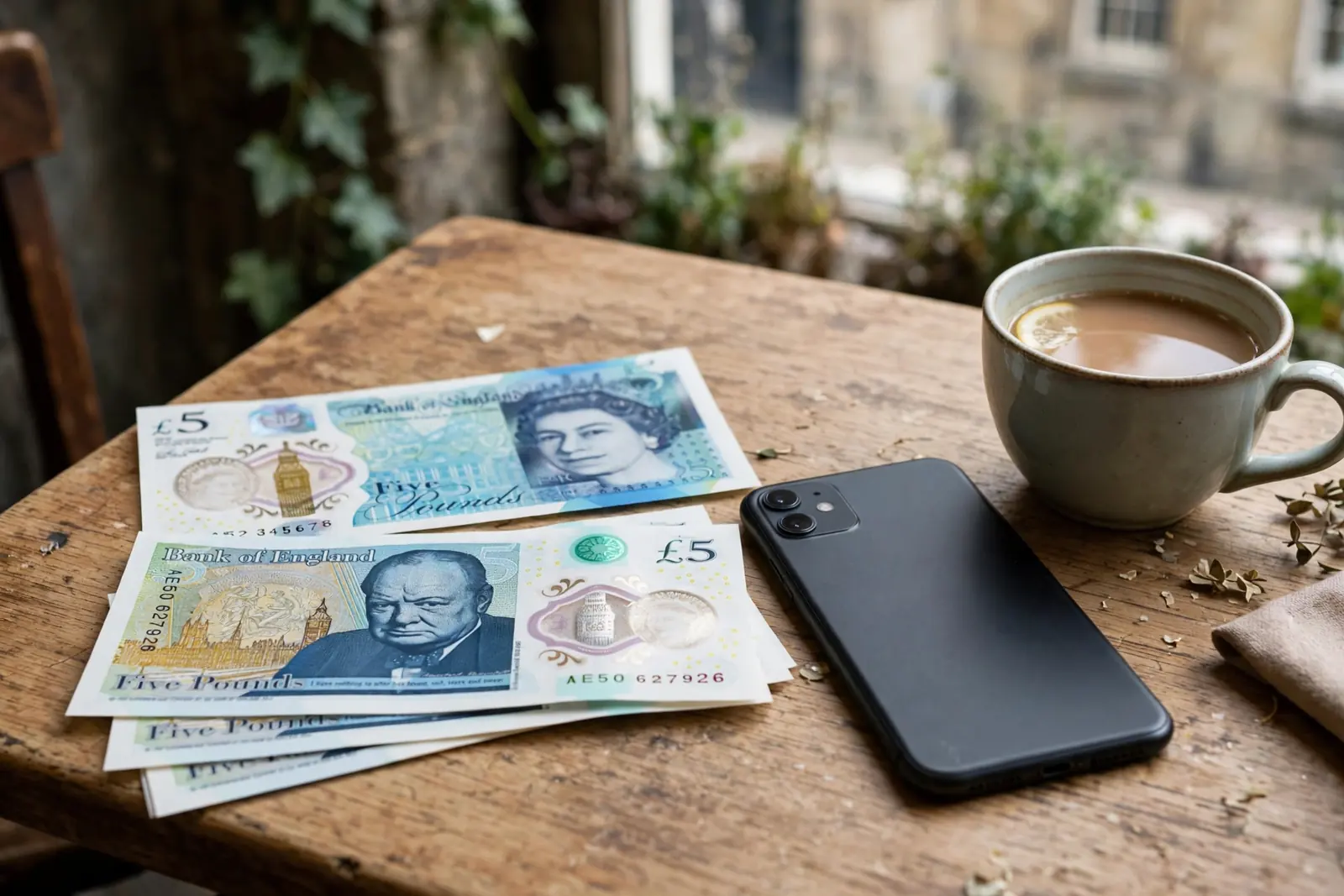
Labels are cheap. Check the detail.
Pay by SMS: A Small Deposit With a Narrower Route
Paying by text can look like a neat fit when you want to put a small amount into a casino account, but it is not a standard option across UK sites. It depends on the operator offering mobile billing and on the particular payment option shown in its cashier. A £4 minimum is therefore something to confirm there, not something to assume from the phrase “pay by SMS”.
A specialist review describes the £1 tier as rare and linked to particular routes, including Boku or Payforit. That does not mean either service will be available at every casino, or that its lowest permitted payment will be the same everywhere. The cashier is the useful bit; the banner is just decoration.
SMS billing is also different from paying by debit card or e-wallet. A specialist review notes that debit cards and some e-wallets can handle £1 transactions, but that does not make those methods interchangeable with mobile billing. Each option can have its own availability and cashier minimum. If SMS is missing from the deposit screen, there may be no way to use it at that operator.
I would check the amount offered in the cashier and the payment terms before confirming. Also make sure the route complies with UK gambling rules: UK-licensed casinos cannot accept credit-card payments for gambling, including credit-card funding routed through a money service business. If the payment route is unclear, pause rather than treating a small charge as harmless.
Text payment can be convenient when it is offered, but it is a narrower route than cards or e-wallets. The £4 figure only matters if that exact option accepts it. No guesswork.
What is the best £1 minimum deposit casino in the UK?
NetBet is the only UKGC-listed casino identified with a £1 cashier minimum deposit. Check the current cashier and terms before depositing.
Which payment method is best for low-deposit casino players?
Debit cards and some e-wallets support £1 transactions. Check the cashier’s minimum for your chosen method, as some operators restrict which methods accept deposits at that level.
Can I take out winnings from a £1 deposit?
Yes, if your balance meets the casino’s withdrawal minimum and you satisfy its terms. Minimum withdrawals can be as low as £1 to £5, while many casinos set them at £10 to £20.
Which payment methods usually accept £1 deposits?
Debit cards and some e-wallets can accept £1 deposits; Boku and Payforit mobile billing are also cited as options at some casinos. Check the cashier because availability varies by operator.
What is the maximum wagering requirement in Great Britain?
Since 19 January 2026, gambling incentives in Great Britain cannot require more than 10x wagering of bonus funds.
Why are there so few £1 deposit casinos?
£1 deposits are limited by operator and payment-method restrictions, and some casinos exclude the lowest deposit tier from welcome offers. The £1 minimum is therefore a rare option rather than a typical UK casino threshold.
Prepared by the Tenobet Casino 1 editorial staff.