Casinos That Accept Bitcoin in the UK: What to Check
 Available in GB
Bitcoin and Bitcoin Cash are separate, and broad crypto claims alone do not show which coins or payment routes a casino supports.

Table of Contents
- How to Judge a Bitcoin Casino Without Chasing a “Best” Badge
- What “Online Bitcoin Casino” Actually Tells You
- Bitcoin Deposits, Bonuses and the Costs Hiding in the Exchange Rate
- Not on GamStop? Check the Limits of That Claim
- Free Spins and Bitcoin Deposits: Read the Bonus Terms First
- Bitcoin Slots in Britain: The Rules That Change How You Play
- Depositing and Withdrawing: Check the Route Works Both Ways
- How to Check a Bitcoin Casino Site Before You Fund It
- Bitcoin Payouts Aren’t Anonymous by Default
- Bitcoin Withdrawals: What “Instant” Leaves Out
How to Judge a Bitcoin Casino Without Chasing a “Best” Badge
A “best” badge is a verdict, not evidence. When I compare claims about a Bitcoin casino, I try to separate what a page says from what it actually demonstrates. A polished review can make a payment option sound settled when the underlying detail is much narrower: perhaps a site mentions cryptocurrency, perhaps it names a coin, or perhaps it simply groups several payment methods together. Those are not interchangeable claims.
That distinction matters if you are looking for Bitcoin Cash. Bitcoin and Bitcoin Cash are separate cryptocurrencies, despite the similarity in their names. A broad statement that a casino is “crypto-friendly” does not establish that it accepts either one, still less that it supports both. A reference to Bitcoin does not confirm Bitcoin Cash, and a general crypto label is not enough to identify which coin a player could use.
A specialist review of the websites it examined reported seeing familiar options such as Visa, Mastercard and bank transfer, alongside e-wallets and several cryptocurrencies. That is a description of what those pages mentioned, not proof that any particular operator supports a particular coin now. It also cannot tell you whether an individual claim is current, complete or applicable to every customer. The scope is limited. So is the conclusion.
If you’re looking for a casino that accepts Bitcoin in the UK, check the available payment methods and withdrawal terms before signing up. The details below give you the stated payout speed for each operator.
Payout speed: 1-3 business days NightLuck lists a payout speed of 1–3 business days. Check whether its current payment options include Bitcoin before you sign up.
Payout speed: 1-3 business days WinBeast lists a payout speed of 1–3 business days. Confirm its current Bitcoin payment support and terms before you choose it.
Payout speed: 1-3 business days NightWin lists a payout speed of 1–3 business days. If Bitcoin is important to you, verify that it is currently available as a payment method.
Payout speed: 1-3 business days BeOnBet lists a payout speed of 1–3 business days. Check its current payment methods and Bitcoin terms before signing up.
Payout speed: 1-3 business days Revery Play lists a payout speed of 1–3 business days. Confirm that Bitcoin is currently supported before you deposit.
Payout speed: 1-3 business days Britsino lists a payout speed of 1–3 business days. Check whether Bitcoin is available and review the payment terms before you sign up.
Payout speed: 1-3 business days EvoSpin lists a payout speed of 1–3 business days. Verify its current Bitcoin support if you want to use cryptocurrency.
Payout speed: 1-3 business days Chanze lists a payout speed of 1–3 business days. Check its current payment options to confirm whether you can use Bitcoin.
Payout speed: 1-3 business days Zombillion lists a payout speed of 1–3 business days. Confirm Bitcoin availability and the applicable payment terms before you choose it.
Payout speed: 1-3 business days Jetsetspins lists a payout speed of 1–3 business days. Check whether Bitcoin is currently supported before you sign up.
I used to treat a payment logo or a confident sentence as if it were a working feature. That was too generous. A logo can be there to describe a general service, a page can lag behind a site, and a review can repeat a claim without showing how it was checked. None of that automatically means the claim is false; it means the evidence has to match the claim you care about.
Match the evidence to the promise
Before trusting a “best Bitcoin casino” label, ask what “best” is supposed to mean. Is the page comparing a named coin, the operator’s UK status, the clarity of its terms, or simply the number of payment logos on display? If it gives no basis for the ranking, the badge tells you little beyond the reviewer’s preference.
I find it useful to sort statements into levels:
- General crypto wording: suggests that cryptocurrency is part of the site’s payment discussion, but does not identify a supported coin.
- A named coin: is more precise, but still does not establish that the option is currently available to you.
- A current, operator-specific confirmation: is stronger evidence because it connects the claim to a particular site and a stated payment route.
- A comparison verdict: is an opinion layered on top of those details, not a substitute for them.
This is not a ranking system. It is a way to stop one kind of evidence from pretending to be another. If a page calls a site one of the best Bitcoin casinos but gives no operator-specific support for that description, I would not treat the label as proof of suitability. “Top pick” is easy to print. The detail behind it is what counts.
The same standard applies to Bitcoin Cash casino claims. Look for the exact coin name rather than assuming that “Bitcoin” covers every similarly named asset. Then consider whether the page clearly identifies the operator and whether its information is tied to that operator rather than repeated across a collection of generic recommendations. A headline may be broad; the supporting detail should be exact.
Keep the UK part in view
Coin support is only one piece of the assessment. For a casino serving customers in Great Britain, the operator must hold the relevant UK Gambling Commission licence. A foreign location or a crypto payment option does not replace that requirement. Before depositing, check the operator’s licence on the Commission’s public register. That is a more meaningful check than a badge awarded by a review page.
The legal position also helps keep the comparison honest: online gambling in the UK is legal for adults aged 18 and over when the operator holds the appropriate UK licence. A claim that a site accepts crypto does not tell you whether it meets that standard. Nor does a high ranking make an offshore operator part of the UK regulatory system.
- Check the operator’s licence on the UKGC public register
- Look for the exact coin name in the cashier
- Verify the operator’s UK status independently
- Trust a “best Bitcoin casino” badge without evidence
- Assume “crypto-friendly” means Bitcoin Cash is accepted
- Treat a payment logo as proof of a working feature
I would not confuse a detailed-looking comparison with a verified one. A page can list many payment types and still leave the key question unanswered: whether a specific UK-facing operator supports the precise cryptocurrency being discussed. Conversely, a cautious page that names fewer features may be more useful if it makes clear what it has actually established.
So when someone calls a site the best Bitcoin casino in the UK, read past the superlative. Check what the claim names, how specifically it connects that coin to an operator, and whether the operator’s UK status can be confirmed independently. If those pieces do not line up, the “best” label is decoration, not a reason to trust the recommendation.
That is the bar I use now. Exact coin. Identifiable operator. Verifiable UK licence. No badge can do those checks for you.
What “Online Bitcoin Casino” Actually Tells You
The phrase “online Bitcoin casino” can sound like a clear promise: you can open an account, send Bitcoin and play. But the words on a landing page do not establish that the payment route is available to you. A site may mention cryptocurrencies in general, describe a feature that is not enabled for every customer, or show information that has not kept pace with its cashier.
I used to treat a coin logo as if it settled the question. It doesn’t. A mention of crypto is a claim to check, not proof that Bitcoin is an available payment option. Nor does a page that refers to several cryptocurrencies confirm that any particular coin can be used in a UK account. The detail that matters is whether Bitcoin appears as a selectable method in the account you are actually using.
A crypto mention is not a working route
There are a few different things a site might mean when it talks about crypto. It could be describing a general feature, listing currencies that are supported somewhere, or referring to a payment route that is unavailable in your location. Those descriptions are not interchangeable. If the site says “crypto accepted” but does not identify Bitcoin in a current payment menu, I would not read that as confirmation.
Even an explicit Bitcoin badge can leave important questions unanswered. Is it available to customers in the UK? Does it appear for your account, rather than only on a promotional page? Does selecting it lead to instructions for a Bitcoin transaction, or to a different payment service? Until the cashier shows a usable option, the claim is still only a claim.
That distinction is the same with ordinary payment logos. A specialist review may list Visa and Mastercard, but that does not settle whether those cards are currently available to UK customers or whether a particular card product is eligible. The cashier is where those details need checking. A logo is a starting point. Not a confirmation.
Why I check the cashier
The cashier is tied to the account and location being used, so it is a more practical check than a general page describing payment features. I would sign in, open the deposit options and look for Bitcoin by name. If it is not listed, I would not assume that a support article, an old review or a graphic elsewhere on the site makes it available.
Checking the Cashier
Log into your account and open the deposit options menu.
Look for Bitcoin explicitly by name rather than a general crypto label.
Read the on-screen instructions to ensure the method and payment details match your intended route.
If Bitcoin is listed, read the on-screen instructions before going further. Check that the method is specifically Bitcoin and that the payment details match the route you intend to use. A broad “digital currency” label is not enough to tell you which coin or service is involved. If the wording is unclear, ask the operator to confirm the exact method and whether it is currently available to UK customers. Keep the answer; a vague reply has not resolved the question.
This is not a claim that every cashier is perfectly clear. Some are easier to understand than others. But it gives you a direct way to test what the site is offering now, rather than relying on a description written for a wider audience or at another time.
Keep the UK account in view
For a UK player, payment availability is only one part of the check. Real-money gambling offered to customers in Great Britain must be provided by a remote gambling licensee holding the relevant UK Gambling Commission licence. A site describing itself as an online Bitcoin casino does not, by that wording alone, establish that it is licensed to serve the UK market.
I would check the operator’s licence on the Commission’s public register and make sure the operator and site details correspond. Then I would return to the account cashier and check the actual payment options. Those are separate checks: a licence does not confirm that Bitcoin is supported, and a Bitcoin option does not establish that the site is licensed for UK customers. Don’t let one stand in for the other.

The same approach applies whether a page calls itself a Bitcoin online casino or simply says it accepts cryptocurrency. Treat the description as a prompt to verify, not as a completed verification. If the cashier gives no clear Bitcoin option, the honest answer is that you have not confirmed one. No detective work with logos can improve that answer. Better to stop there than to guess.
I also avoid confusing a site’s general payment list with what is available after signing in. A method can be named on an information page without appearing in the account’s current options. Conversely, a cashier can make clear that a payment feature is restricted or unavailable. What you see in the actual account is the useful evidence for your decision.
So, when you see “Bitcoin accepted”, slow down and ask what that means for your account in the UK. Look for Bitcoin itself in the cashier, confirm that the instructions identify the method clearly, and check the operator’s UKGC status separately. If any part remains uncertain, ask the operator before proceeding. A confident-looking label is easy to publish. A route you can actually select is a different matter.
Bitcoin Deposits, Bonuses and the Costs Hiding in the Exchange Rate
A Bitcoin deposit can look simple on the button and still be hard to price. Before sending anything, I check what the casino will credit to the account, what currency the account uses and what the transaction costs from end to end. The number shown beside the deposit option is only one part of it.
Conversion spreads—the gap between the transaction rate and a reference rate—can cost more than visible fixed fees.
A specialist review reports GBP support on the pages it examined, but that is not a reason to assume every account will be set up in pounds. Confirm the account currency before your first transaction. If you send Bitcoin and the balance is handled in another currency, conversion can affect what you see in the cashier and what you can use to play. Get that detail straight first.
Check the minimum and the full cost
The minimum deposit is not necessarily the same for every payment method. One specialist review puts the starting range at £10–£20, depending on the method selected; treat that as a guide from that review, not a promise about the cashier in front of you. Check the live minimum and any maximum shown for your chosen route. Maximum deposits can differ by method and account status, and may be set per transaction or across a day or month.
Then look beyond a stated flat charge. A specialist review notes that costs may come from the casino, payment provider, bank or issuer, exchange-rate spread, and the Bitcoin network. Not every route will involve every charge, so check the ones that apply to your transaction rather than adding them all together automatically.
The exchange rate deserves a close look. A conversion spread is the gap between the rate used for your transaction and a reference rate; it can take a larger bite than a visible fixed fee, according to that specialist review. If the cashier displays a conversion, compare the amount you send with the amount credited before confirming. A small-looking fee is not the whole price. That is where I used to stop reading—and regretted it.

Read the offer before opting in
A Bitcoin casino deposit and a casino bonus are separate questions. Seeing a promotion beside the cashier does not establish that Bitcoin qualifies. Check the offer’s payment-method rules before opting in, and look for wording that excludes some deposit routes or limits which deposits count. If it is unclear, ask the operator to confirm in writing before you fund the account.
Be just as careful with a “no deposit bonus” label. It describes an offer that does not require a deposit to claim, but the label alone tells you neither who can claim it nor what conditions apply. Read the eligibility rules and the terms attached to the bonus, including any restrictions on how it can be used. Do not assume a Bitcoin payment will unlock an offer, or that an offer described as no-deposit is connected to Bitcoin at all.
The same applies when a promotion mentions free spins or a headline reward: the cashier’s payment options do not prove bonus eligibility. If you cannot find a clear answer in the terms, pause rather than depositing on an assumption. I have learned that a bonus is only worth considering once I know what triggers it and what rules come with it. No guesswork.
Not on GamStop? Check the Limits of That Claim
“Not on GamStop” can sound like a payment feature when Bitcoin is mentioned beside it. It isn’t. The label tells you nothing by itself about whether Bitcoin is accepted, what account controls apply or whether the site is suitable for you.
Self-Exclusion Risk
Looking for a Bitcoin casino not on GamStop to bypass self-exclusion is a risky workaround and not a safe alternative to established boundaries.
The first distinction I’d make is between a UK-licensed casino and a site operating outside the UK Gambling Commission’s system. A remote gambling licensee serving customers in Great Britain must hold the relevant UKGC licence, wherever the company is based. An offshore site does not become UK-licensed because it accepts UK customers, uses sterling or advertises a Bitcoin cashier. And a claim about GamStop cannot tell you which category you are looking at.
That matters because “outside the scheme” is not the same as “a better choice”. If you have self-excluded because gambling was becoming difficult to control, looking for a Bitcoin casino that is not on GamStop may be an attempt to get around a boundary you chose for a reason. I’ve made enough bad calls to know that a payment option can make a risky decision feel like a clever workaround. It isn’t one.
The account controls are the useful test
For a UK-licensed casino, the important question is not whether the site uses a reassuring phrase. UKGC rules require remote operators to ask new customers to set a financial limit before their first deposit and to make account-level limit controls accessible. Those are practical protections to look for in the account, not decorative wording on a landing page.
Check that you can find the controls after signing in, understand what they let you restrict, and know how to use them before you fund the account. If the site’s claims are confusing, or the controls are hard to locate, pause rather than treating the Bitcoin option as a reason to carry on.
A UKGC-licensed casino must also provide responsible-gambling tools, including self-exclusion. That does not mean a “not on GamStop” label proves that a particular site is licensed, or that every site using Bitcoin offers the safeguards you expect. Verify the operator’s current licence on the UKGC public register. If it is not there, don’t read the label as evidence of protection.
Don’t confuse access with suitability
People search for Bitcoin casinos not on GamStop for different reasons: curiosity about crypto, frustration with restrictions, or a wish to gamble after self-excluding. Those situations are not interchangeable. The same site can look like a payment solution while leaving the more important question unanswered: whether you should be gambling there at all.
If you have chosen self-exclusion, don’t try to defeat it by switching to a different payment method or looking for a site outside the UK system. Step away from the deposit screen and use the support or blocking tools available to you. If you are simply comparing payment options, assess licensing and account controls separately from whether a cashier displays Bitcoin.
The phrase does not settle anything. Check the safeguards, not the slogan.
Free Spins and Bitcoin Deposits: Read the Bonus Terms First
A “free spins” banner can look like a straightforward extra: make a deposit, claim the offer, start playing. I’ve learned not to treat the banner as the rules. The important detail is whether the offer applies to your account and the payment method you plan to use. A Bitcoin casino with free spins is only useful to you if its current terms actually connect those spins to a Bitcoin deposit.
Claiming Free Spins
- Read the full promotion terms
- Confirm Bitcoin deposits qualify for the offer
- Check for payment-method exclusions
- Verify if an opt-in is required
- Identify restricted games or wagering conditions
I would check the full promotion terms before depositing, not after. Look for whether you must opt in, which deposit methods qualify, and whether the offer is restricted to particular games or accounts. The wording may also set conditions for using the spins or any winnings from them. Those details vary by promotion; a headline does not establish them.
Does Bitcoin qualify?
A site mentioning Bitcoin somewhere does not, by itself, show that Bitcoin deposits qualify for a free-spins offer. Nor does a page advertising free spins prove that the promotion is available to every customer. Check the offer’s own terms and the cashier together: the cashier tells you which payment options are currently available to your account, while the promotion rules tell you whether using one of them affects eligibility.
If the terms are unclear, ask customer support to confirm the specific point in writing before you deposit. Keep the answer. It is far easier to resolve a mismatch before you have opted in than to argue later that a banner sounded broader than its conditions.
Payment-method exclusions are not limited to crypto. One affiliate review reports that PayPal may be excluded from bonus eligibility, and reports that Skrill and Neteller are often excluded from promotions. Treat those as prompts to check the current offer, not as rules that apply to every casino. A payment option can be available for deposits and still fail to qualify for a particular bonus.
Read the condition, not the headline
The phrase “Bitcoin casino free spins” can make an offer sound tailored to crypto users. That wording alone does not confirm a Bitcoin-specific promotion. Check whether Bitcoin is named as an eligible deposit method, whether the bonus needs to be claimed before depositing, and what happens if you use a different method. If there is no clear answer, do not assume.
Also check what the offer means by “free”. The spins may come with restrictions on the games they can be used on, a period for claiming or using them, or conditions attached to resulting winnings. I’m not suggesting any particular offer has those restrictions; I’m saying the terms are where they would be stated. Read the actual promotion rather than relying on a short description or an old review.
If the details conflict across pages, pause and get clarification from the operator. Save the terms as they appear when you make your decision. Promotions can change, and a general page may not match the offer shown in your account.
A sensible check is simple: confirm that the offer is current, that Bitcoin deposits qualify, and that you understand the conditions before opting in. If any part is missing or vague, treat the spins as unconfirmed—not as money already waiting for you. That’s the less exciting answer. It’s also the useful one.
Bitcoin Slots in Britain: The Rules That Change How You Play
A Bitcoin label does not create a separate set of rules for the games. If you are playing online slots in Britain, the UK rules still shape how each spin works, whether the balance is shown in pounds or the site advertises a crypto payment route. I used to think the payment method was the main thing to check. It isn’t once you are actually playing.
UK Slot Rules
- Autoplay is banned for online slots in Britain.
- Every spin must last at least 2.5 seconds.
- Maximum stakes per game cycle are £5 for adults 25+ and £2 for players 18–24.
Autoplay is banned for online slots in Britain. You have to start each spin yourself; a button that keeps spinning while you sit back is not an allowed feature on a UK-licensed casino. That applies to Bitcoin-branded slot pages too. “Hands-free” is not a perk here.
There is also a minimum spin duration: each online slot spin must last at least 2.5 seconds. That can make play feel slower than a game or site promotion suggests, but it is a player-protection rule, not a setting you can switch off. The pace is fixed.
Stake limits apply to the game
The maximum stake per online slot game cycle is £5 for customers aged 25 and over. For players aged 18 to 24, it is £2. The £5 limit for all adults came into effect on 9 April 2025. These are limits on the stake in a game cycle, not a promise about what a slot will pay. A jackpot title does not get a different cap just because the prize is large.
So if you are looking at Bitcoin casino slots or a page calling them Bitcoin slot machines, check what the game actually lets you stake and how a cycle is defined in its rules. The Bitcoin wording describes a payment angle; it does not tell you that a slot has different mechanics, a bigger permitted stake or special jackpot treatment.
The UK licence matters
Remote gambling licensees offering real-money gambling to customers in Great Britain must hold the relevant UK Gambling Commission licence. Online gambling is legal in the UK for people aged 18 and over when the operator holds that licence, and operators must verify age before allowing deposits. A Bitcoin payment option does not sidestep any of this.

I’d check the licence on the UKGC public register before funding an account, then look for the operator’s game rules if a feature is unclear. The useful test is not whether a page says “Bitcoin slots UK”; it is whether the operator and the game follow the rules that apply here. Marketing labels are cheap. The rules are not optional.
Depositing and Withdrawing: Check the Route Works Both Ways
A payment button can look like a complete route when it only gets money into the account. I learned to separate “deposit method” from “deposit and withdrawal method”: they are not interchangeable labels. Before treating a Bitcoin casino site as practical for you, check whether Bitcoin is available for both directions, not just shown beside the deposit options. A one-way route can leave you needing a different way to receive a balance.
That distinction applies to familiar methods too. UK casinos commonly accept debit cards, including Visa and Mastercard, but a card being listed for deposits does not, by itself, tell you how withdrawals are handled. Paysafecard is a prepaid voucher and is deposit-only, so it cannot take a payout back. That is a simple mismatch to spot before you choose how to fund an account.
Open banking and bank transfers may work in both directions at some sites. A specialist review describes these methods as capable of instant deposits and fast withdrawals at many sites, but that is not a promise for every casino or account. The important point here is compatibility: does the same route take money out as well as put it in? A fast-sounding deposit option is no help if the payout route is different from the one you expected.
Attention: A payment method listed for deposits is not always available for withdrawals; some, like Paysafecard, are deposit-only.
With Bitcoin, don’t assume that the word “crypto” settles the question. A site might mention cryptocurrencies without making the same coin available for both deposits and withdrawals. Nor should you assume a payout can be sent to any wallet or address you choose. The route offered by the operator matters, and you need to understand its conditions before relying on it.
I now look at the transaction as a round trip, not a deposit button. Write down the method you plan to use, then check whether it is supported for withdrawals too. If the casino requires a different route on the way out, work out what that means for you before putting money in. Less glamorous than a bonus banner. More useful.
How to Check a Bitcoin Casino Site Before You Fund It
A Bitcoin casino list can look definite while describing payment options that have changed. I treat any list of Bitcoin casinos as a starting point, not proof that a particular site currently accepts Bitcoin from UK customers. Before sending money, I go to the cashier while signed in and check what the account can actually use.
Start with the currency shown for your account and the deposit screen. Is Bitcoin explicitly available, or does the site mention cryptocurrency somewhere else without offering it as a payment choice? Check what currency the account balance will use, too. A specialist review has reported GBP support, but your account’s setting is what matters before you commit to a transaction.

Then read the cashier’s limits for the method you intend to use. Check the minimum deposit and any maximum that applies to a transaction, a day or a month. Those ceilings can depend on the payment method and account status, so a figure on an old page may not apply to you. If the cashier does not show the terms clearly, ask support before depositing. Don’t guess.
Payment logos are not enough. A specialist review has listed Visa and Mastercard, but that does not establish that either is currently available to every UK customer or eligible for every card product. Check the options shown in your own cashier. In the UK, credit-card payments for gambling are prohibited, so do not try to route a credit card through another service to make a deposit.
I also check who operates the site. For a legal online casino serving UK players, the remote gambling operator needs a current UK Gambling Commission licence. Look up the licence number on the Commission’s public register; a badge or a claim on the site is not the same check. The operator must verify your age before allowing a deposit, and UK rules require it to prompt new customers to set a financial limit before their first deposit.
That is my practical test for whether a Bitcoin casino site is worth considering: the cashier must show the payment option and its current terms, and the operator’s licence must stand up to an independent check. If either part is unclear, I stop there. No deposit yet.
Verifying a Casino
- Confirm Bitcoin is explicitly available in your signed-in cashier
- Check live minimum and maximum deposit limits for the specific route
- Verify the operator’s UK Gambling Commission licence on the public register
- Ensure the operator prompts you to set a financial limit before your first deposit
Bitcoin Payouts Aren’t Anonymous by Default
Bitcoin can make a payment look less personal than a bank transfer: a wallet address is not your name. That does not mean a casino payout is anonymous. The operator may still need to establish that the account and the payment route belong to you, and UK anti-money laundering rules generally expect funds to go back to their original source.
I used to treat “crypto” as shorthand for “no questions asked”. That was a bad assumption. A Bitcoin casino payout UK players request can still involve checks linking the gambling account to the person asking for the money. If the details do not line up, a payout can run into avoidable ownership questions. A wallet address is not a disguise.
The practical point is consistency. Use account details that are yours, and check whether the payment route you plan to use is also in your name or under your control. The cleanest arrangement is often one named account used for both depositing and withdrawing. If you are considering Bitcoin, ask the operator what it accepts as proof that the wallet belongs to you, and how it applies its closed-loop rules to crypto. Do not assume that any address you paste into a form will be treated as yours without further checks.
There is a difference between privacy from people who see a transaction and anonymity from the casino handling it. Your payout request is tied to your account, and the operator may need enough information to satisfy its controls. That is not the same thing as a guarantee that every Bitcoin casino payout follows an identical process; the operator’s own rules matter.
Before you deposit, read the payment terms with the later payout in mind. If the casino requires a return to the original source, make sure you understand how that works for the Bitcoin route you are using. A fast payout claim does not answer an ownership question. Different issue.
Bitcoin Withdrawals: What “Instant” Leaves Out
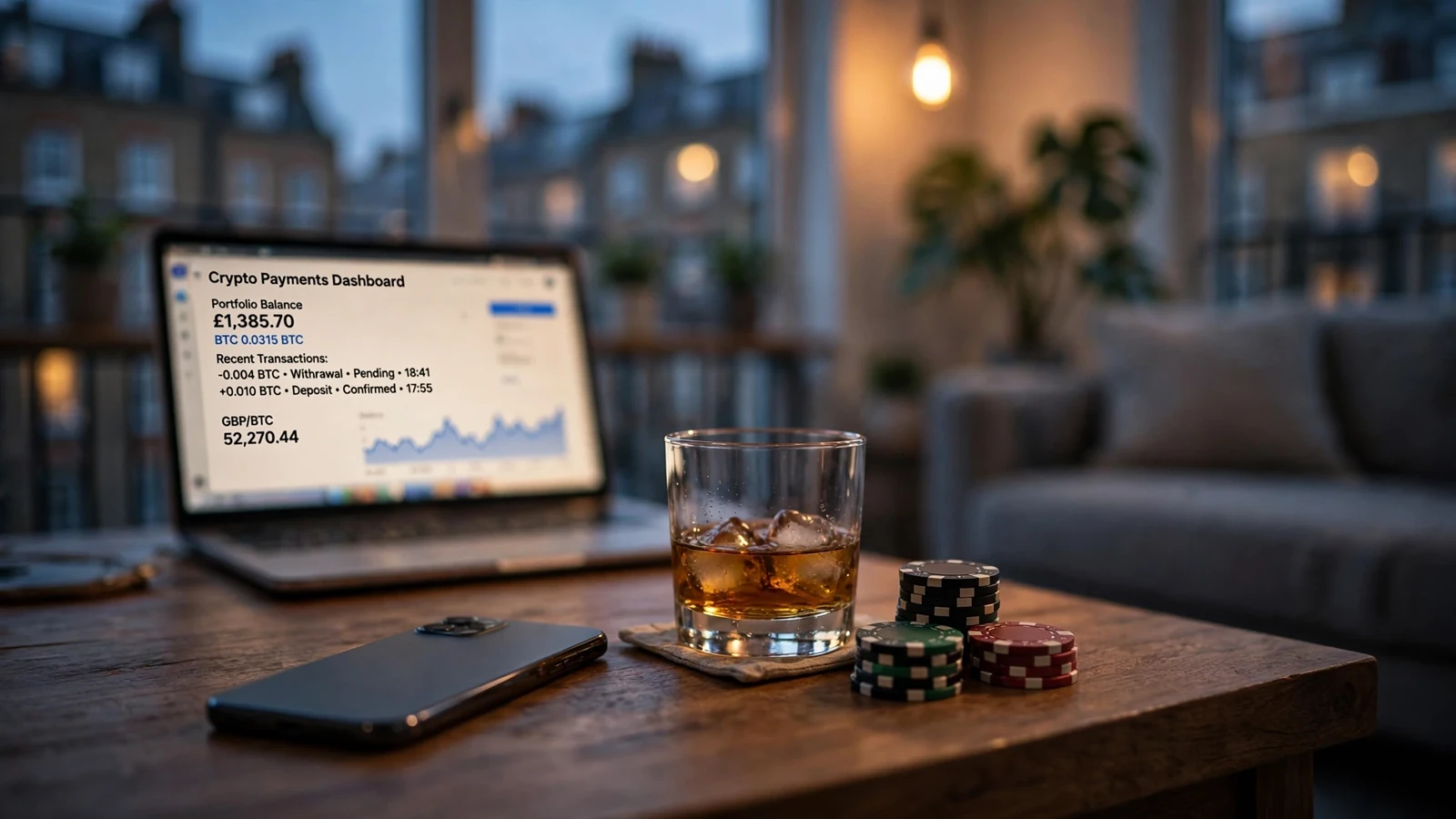
“Instant” is a slippery word on a withdrawal button. It can describe how quickly a request is submitted, not when the money is ready for you to use. I’ve learned not to treat a fast-looking cashier message as a payout time. There is a review step in between.
A specialist review notes that withdrawal processing can include the casino’s own approval, and that a first withdrawal may take longer while verification is completed. That is a useful distinction, not a timetable for every casino with Bitcoin. The actual delay depends on the operator’s process and whether your account is fully verified.
In practice, the status labels matter. “Requested” does not necessarily mean approved; “approved” does not necessarily mean the Bitcoin has arrived. Read the wording the cashier uses, and check whether its estimate covers the operator’s review, or only the step after approval. If the site gives no clear explanation, ask support before relying on an advertised speed.

The first payout is where an “instant” claim can feel especially misleading. If KYC is still outstanding, the operator may need to finish those checks before processing the withdrawal. That can add time before any transfer stage begins. Have the required account verification completed early where possible, and keep an eye on messages asking for further information. A request sitting unanswered will not move itself along.
I would also treat a Bitcoin payout promise as something to verify in the account, not a general feature of every online casino that accepts Bitcoin. Availability and timing can differ by operator, account status and the terms shown at the point of withdrawal. No slogan can tell you how long approval will take.
So when you see “instant”, look for the conditions attached to it: when the clock starts, whether approval is included, and what happens if verification is pending. If those details are vague, the speed claim is vague too. Check first. Then decide.
What is the fastest withdrawal method for UK casinos?
PayPal, open banking services and debit cards connected to fast payout systems are generally among the quickest. The casino’s approval process and your verification status can also affect how soon you receive the money.
Is Skrill available?
Yes, Skrill is offered at some UK-friendly casinos and remains a common deposit method. Check the casino’s cashier to confirm it is available for your account; it may be excluded from promotions.
Which method has the lowest fees?
There is no universally lowest-fee method. Compare the casino’s charges, provider or bank fees, currency conversion spread and any network costs for the amount you plan to transfer.
Why can a fast payout casino still delay my withdrawal?
A casino’s internal approval process can add time, and first withdrawals may take longer while verification is completed. Your account being fully verified can affect the payout speed.
Are fast casino withdrawals guaranteed?
No. Withdrawal speed depends on the casino’s approval process and whether your account is fully verified.
Why must withdrawals return to the deposit method?
Returning funds to the original payment source is a common anti-fraud and anti-money-laundering control. An alternative route may require additional verification.
Published by the Tenobet Casino 1 team.